
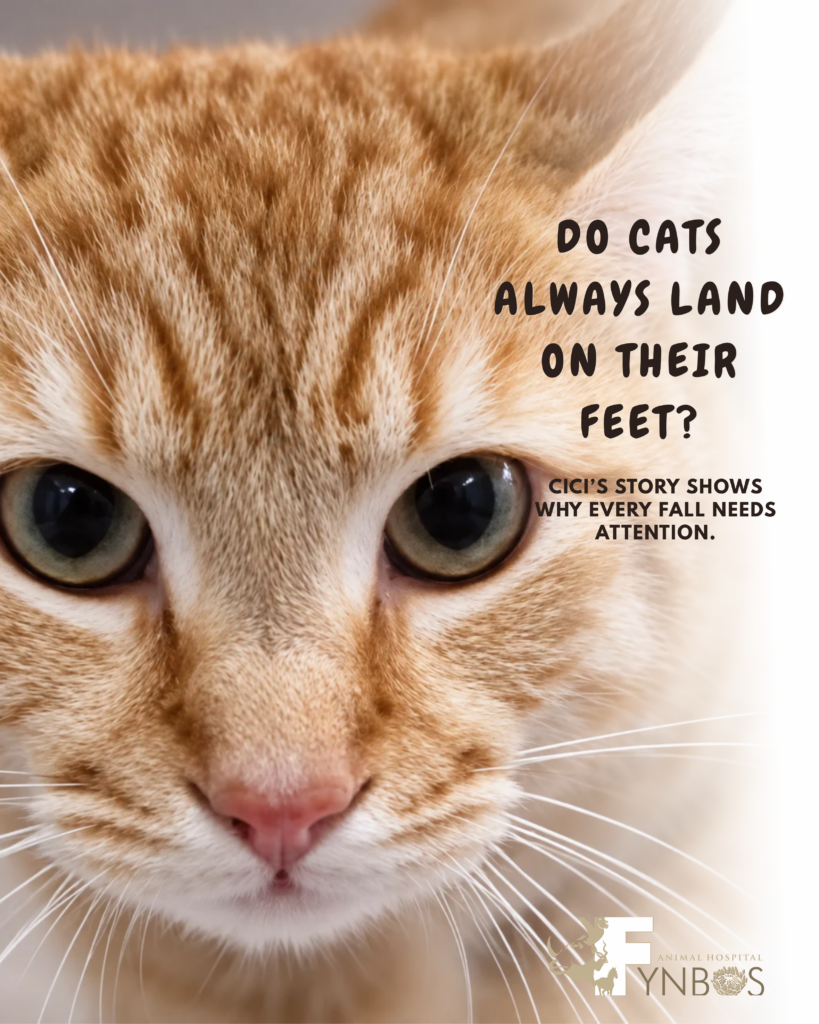
Most cat owners have heard the saying: “Cats always land on their feet.”
There is some truth behind the idea. Cats have an impressive natural ability to turn their bodies while falling and position their feet towards the ground.
But landing on four paws does not mean a cat walks away without injury.
A fall from a window, balcony, wall, roof, tree, cupboard or other elevated surface still places significant force on a cat’s body. Broken bones, chest injuries, abdominal trauma and facial injuries all occur after falls. Some injuries become obvious immediately. Others only show signs later.
For cat owners, the important question is therefore not only, “Did my cat land on its feet?”
The better question is, “Is my cat showing any signs of injury after the fall?”
𝐖𝐇𝐘 𝐃𝐎 𝐂𝐀𝐓𝐒 𝐎𝐅𝐓𝐄𝐍 𝐋𝐀𝐍𝐃 𝐎𝐍 𝐓𝐇𝐄𝐈𝐑 𝐅𝐄𝐄𝐓?
Cats have what veterinarians call a righting reflex.
During a fall, a cat’s balance system helps determine which way is up. The cat then rotates the body and attempts to position the feet towards the ground before landing. A flexible spine also helps with this movement. Most kittens develop this righting ability by around seven weeks of age.
This impressive reflex explains why many cats seem to recover from jumps and falls with surprising ease.
Yet a righting reflex offers no guarantee of a safe landing.
The surface, height, body position, force of impact and the cat’s physical condition all influence the outcome. Veterinary research into high-rise syndrome also shows falls from two or more storeys are linked with orthopaedic, chest, abdominal and facial trauma.
𝐋𝐀𝐍𝐃𝐈𝐍𝐆 𝐎𝐍 𝐓𝐇𝐄𝐈𝐑 𝐅𝐄𝐄𝐓 𝐃𝐎𝐄𝐒 𝐍𝐎𝐓 𝐌𝐄𝐀𝐍 𝐓𝐇𝐄𝐘 𝐀𝐑𝐄 𝐔𝐍𝐈𝐍𝐉𝐔𝐑𝐄𝐃
Four paws touching the ground first might look reassuring.
The force from the landing still travels through the legs and body.
Falls are a recognised cause of fractures in cats, including fractures involving the femur and other long bones. Trauma also affects joints, the chest, abdomen, head and jaw.
A cat might also walk away from a fall and hide shortly afterwards.
Cats often hide discomfort, so visible behaviour deserves close attention following trauma.
A cat who appears quiet after a fall is not necessarily “fine”.
𝐖𝐇𝐀𝐓 𝐈𝐍𝐉𝐔𝐑𝐈𝐄𝐒 𝐌𝐈𝐆𝐇𝐓 𝐎𝐂𝐂𝐔𝐑 𝐀𝐅𝐓𝐄𝐑 𝐀 𝐂𝐀𝐓 𝐅𝐀𝐋𝐋𝐒?
The type of injury depends on how and where the cat lands.
Orthopaedic injuries include fractures, joint trauma, sprains and dislocations. Falls also lead to chest and abdominal trauma, while facial or jaw injuries occur in some cases.
A fracture does not always mean bone protrudes through the skin or a leg sits at an obvious angle.
Lameness, swelling and pain are common fracture signs. X-rays help veterinarians determine the location and severity of a fracture.
𝐖𝐀𝐑𝐍𝐈𝐍𝐆 𝐒𝐈𝐆𝐍𝐒 𝐀𝐅𝐓𝐄𝐑 𝐀 𝐅𝐀𝐋𝐋
Watch your cat closely following a fall or hard landing. Veterinary assessment becomes especially important when you notice:
- Limping or refusing to place weight on a leg
- Reluctance to stand, walk or jump
- Pain when getting up or lying down
- Swelling around a limb or joint
- A stiff or unusual walking pattern
- Difficulty breathing or rapid breathing
- Unusual hiding, lethargy or reduced interaction
- Crying, growling or reacting when touched
- Reduced appetite or difficulty eating
- Bleeding, visible wounds or an abnormal limb position
Some fall-related injuries appear straight away, while other signs emerge hours later.
𝐌𝐘 𝐂𝐀𝐓 𝐅𝐄𝐋𝐋 𝐁𝐔𝐓 𝐒𝐄𝐄𝐌𝐒 𝐅𝐈𝐍𝐄. 𝐒𝐇𝐎𝐔𝐋𝐃 𝐈 𝐒𝐓𝐈𝐋𝐋 𝐖𝐎𝐑𝐑𝐘?
A normal walk immediately after a fall does not rule out injury.
Internal trauma, pain and some orthopaedic injuries are less obvious during the first few hours. Stress and adrenaline also affect how an animal behaves shortly after an accident.
Following a significant fall, monitor breathing, movement, appetite and behaviour closely.
A serious fall, breathing difficulty, inability to walk, obvious pain or suspected fracture requires prompt veterinary attention. Veterinary emergency assessment often includes a physical examination, followed by X-rays or other diagnostic tests where needed.
𝐖𝐇𝐀𝐓 𝐀𝐁𝐎𝐔𝐓 𝐀 𝐂𝐀𝐓 𝐉𝐔𝐌𝐏𝐈𝐍𝐆 𝐅𝐑𝐎𝐌 𝐅𝐔𝐑𝐍𝐈𝐓𝐔𝐑𝐄 𝐎𝐑 𝐀 𝐖𝐀𝐋𝐋?
Cats jump every day.
Most routine jumps end without injury, yet an awkward landing from a cupboard, wall, tree or piece of furniture still places stress on bones and joints.
A slip, poor landing surface or unexpected movement changes the landing.
Pay attention when your cat suddenly starts limping after a jump, refuses to jump again, hides, or becomes sensitive when touched.
A change from your cat’s normal movement matters more than whether the height looked dangerous to you.
𝐂𝐈𝐂𝐈’𝐒 𝐒𝐓𝐎𝐑𝐘: 𝐖𝐇𝐘 𝐀 𝐐𝐔𝐈𝐂𝐊 𝐑𝐄𝐒𝐏𝐎𝐍𝐒𝐄 𝐌𝐀𝐓𝐓𝐄𝐑𝐒
Cici’s case at Fynbos Animal Hospital offers an important lesson about trauma.
Cici suffered a traumatic injury to the left femur, resulting in a Salter-Harris Type I fracture with severe trauma and displacement.
A Salter-Harris Type I fracture involves separation through the growth plate. Growth plate injuries require careful veterinary assessment, especially in young animals, because this area plays an important role in normal bone development.
After surgery, Cici made excellent progress.
Only two weeks post-op, he was already placing good weight on the injured leg and was ready to move into the next stage of rehabilitation.
His story carries an important message beyond one fracture.
Prompt action after trauma matters.
𝐖𝐇𝐄𝐍 𝐒𝐇𝐎𝐔𝐋𝐃 𝐘𝐎𝐔 𝐂𝐎𝐍𝐓𝐀𝐂𝐓 𝐘𝐎𝐔𝐑 𝐕𝐄𝐓𝐄𝐑𝐈𝐍𝐀𝐑𝐈𝐀𝐍?
Do not rely on the belief that cats always land safely.
Contact your veterinarian after a significant fall or accident, especially when your cat shows pain, lameness, breathing changes, reduced appetite, unusual behaviour or difficulty moving.
Early assessment gives your veterinary team a clearer opportunity to identify fractures, internal trauma or other injuries and start the appropriate treatment.
For cat owners in Worcester, Rawsonville, Villiersdorp, Ceres, De Doorns and Robertson, Fynbos Animal Hospital provides veterinary support when an accident or unexpected injury needs professional attention.
𝐇𝐄𝐋𝐏 𝐑𝐄𝐃𝐔𝐂𝐄 𝐓𝐇𝐄 𝐑𝐈𝐒𝐊 𝐎𝐅 𝐅𝐀𝐋𝐋𝐒 𝐀𝐓 𝐇𝐎𝐌𝐄
Cats naturally seek elevated spaces, so prevention centres on making those spaces safer.
Secure windows and balconies where appropriate. Keep unstable furniture away from open windows. Check screens regularly. Provide stable climbing structures and safe elevated resting areas indoors.
Pay extra attention to young, active cats who climb, chase and jump without much hesitation.
The goal is not to stop normal feline behaviour. The goal is to reduce access to unsafe drops and unstable surfaces.
𝐂𝐈𝐂𝐈’𝐒 𝐌𝐄𝐒𝐒𝐀𝐆𝐄 𝐅𝐎𝐑 𝐄𝐕𝐄𝐑𝐘 𝐂𝐀𝐓 𝐎𝐖𝐍𝐄𝐑
Cici’s recovery reminds us why a prompt response during an emergency matters.
A cat might land on its feet.
A cat might walk away.
A cat might even seem fine at first.
None of those signs guarantee the absence of injury.
If your cat suffers a significant fall, accident or sudden trauma, contact your veterinarian as soon as possible.
Early attention played an important role in Cici’s journey from emergency to recovery.
Fynbos Animal Hospital
Professional veterinary care when your pet needs help most.